Local, not cloud
Imported offline data is stored in app-owned storage or at a file location you choose. There is no ArxSilex cloud sync for maps, POI, terrain or projects.
Offline
Prepare maps, POI, elevation models, raster overlays and map styles so ArxSilex MapTools remains useful outdoors without mobile coverage.
Last updated: May 27, 2026
Data center
Offline use is more than one map file on the device. A useful field view depends on matching maps, POI, elevation models, overlays, profiles and map styles.
Imported offline data is stored in app-owned storage or at a file location you choose. There is no ArxSilex cloud sync for maps, POI, terrain or projects.
The app uses the Android file picker. You select files deliberately; ArxSilex MapTools does not request broad storage access to the whole device.
Smart Import analyzes files by content and suggests a target: base map, layer, raster overlay, POI, terrain, render theme or project.
The offline status shows whether map, POI, elevation data, active profile and map style are available for a position or whether online tiles would still be needed.
Map profiles combine map, active layers, terrain, POI display and map style. This lets you switch between outdoor, field and specialist views.
OpenAndroMaps, OpenStreetMap, your own GIS data, authority maps or commercial data may have their own license terms. The app does not automatically bundle external map data.
Terms
ArxSilex MapTools uses these terms deliberately. They make it clear whether a file is used as a base map, editable geometry, image overlay or elevation data source.
| Term | Short definition | Examples |
|---|---|---|
| Maps | Base maps used as the main working view. | OpenStreetMap, OpenAndroMaps, offline .map, MBTiles as a base map |
| Vector layers | Additional object, line or polygon data above the map. The content consists of points, lines or areas and can often be displayed or evaluated individually. | GPX, KML, GeoJSON, Shapes, KML polygons, GeoJSON areas, GPX tracks as overlays |
| Raster overlays | Georeferenced image or tile data above the map. They are placed as a finished image surface and are not interpreted as individual objects. | GeoTIFF, MBTiles, image maps, aerial imagery, scanned maps, georeferenced plans |
| Elevation data / terrain | Data sources for elevation values and terrain analysis. They are not a visible map in the narrow sense, but provide height information. | HGT, DEM GeoTIFF, ASC, DTED |
| Map style | Rendering rules for vector maps. The style defines colors, symbols, paths, POIs, contour lines and other map elements. | OpenAndroMaps render theme, Elevate Theme |
| POI data | Search and display data for places and points of interest. | OpenAndroMaps .poi, custom POI files |
Vector layers contain individual geometries. They are useful for planning data, boundaries, search areas, routes, tracks and imported project information.
Raster overlays are finished image surfaces above the map. They are useful for aerial imagery, historical maps, scans or special map views. Opacity is often adjusted so the base map remains visible below.
Maps, vector layers and raster overlays can be shown on the map. Elevation data is usually used by tools: point elevation, elevation profile, hillshade, contour lines and viewrange.
Sources
ArxSilex MapTools does not ship third-party map data. Download the files from the relevant provider, check license and format, then import them deliberately into the app.
| Data type | Suitable sources | Notes |
|---|---|---|
| Offline base maps | OpenAndroMaps General Maps OpenAndroMaps Countries and Regions Examples: Germany, Europe, USA, South and Middle America, Canada, Australia, New Zealand, Oceania, Asia and Middle East, Russia, Africa | For OpenAndroMaps, choose a world, country or regional map on the source page. Import ZIP files with Karte_Map in the name as Map/Custom; import POI_Normal...poi.zip as POI. |
| POI, layers and OSM/GIS data | BBBike Extracts Geofabrik Downloads | BBBike and Geofabrik provide OSM extracts and GIS formats such as GeoJSON, Shapefile or GeoPackage. Not every raw format is directly an app map; import only supported formats. For Geofabrik, the relevant app format is usually .gpkg.zip when a GeoPackage download is available for the selected region. |
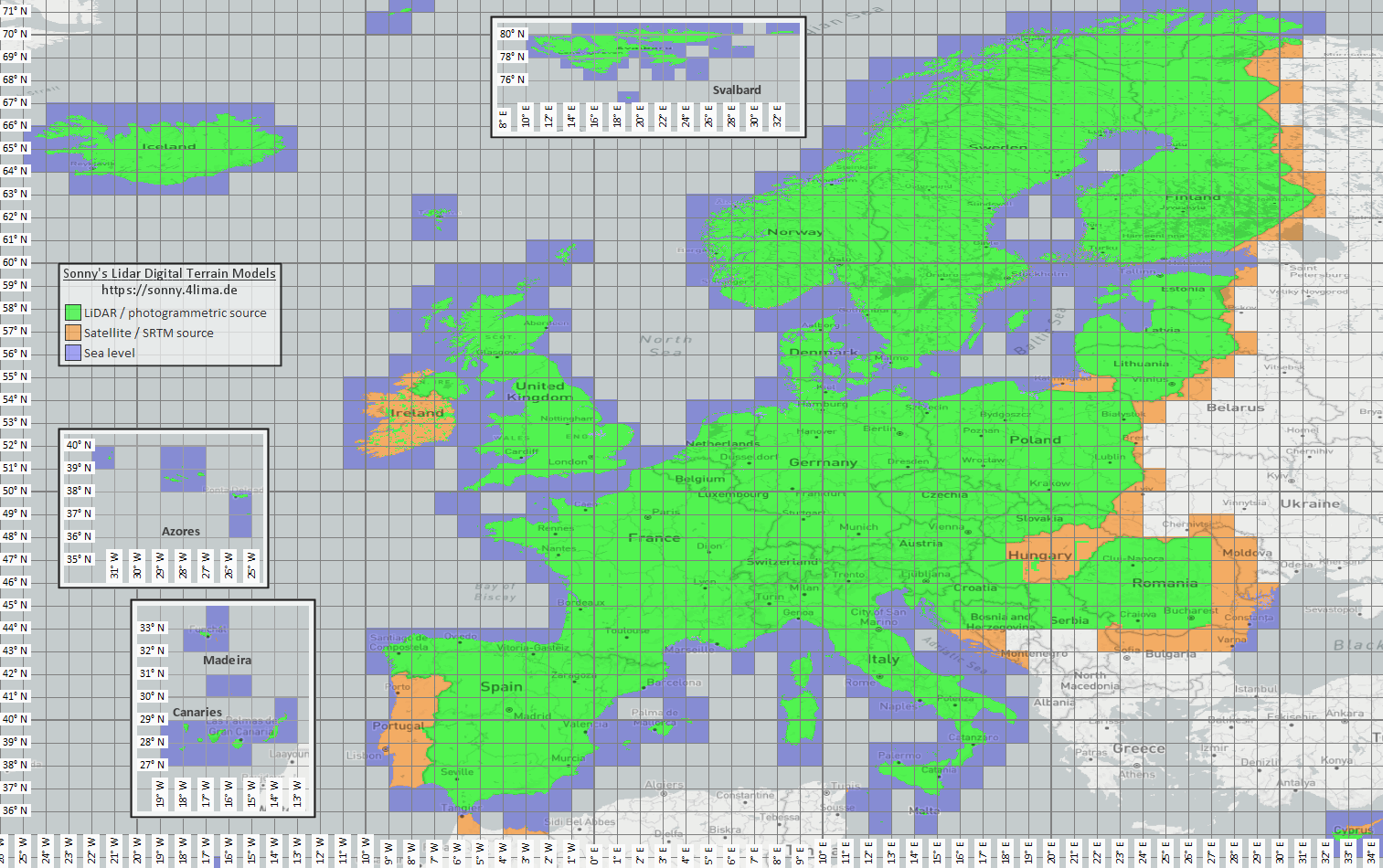
| Elevation and elevation data | Sonny LiDAR DTM Sonny DTM overview map USGS SRTM OpenTopography Copernicus Data Space | Sonny provides European digital terrain models as a source for elevation data. DTM 1" and DTM 3" are grids in arc seconds, roughly about 30 m and 90 m at the equator; DTM 20m and DTM 50m state the grid spacing directly in meters. Finer resolution needs more storage and import time. Use the overview map to find the matching coordinate/region, then select it on the source page. |
| Raster overlays and special maps | Open-data portals | Government portals, open-data portals or your own GIS projects may provide GeoTIFF, KML/KMZ, MBTiles or GeoPackage. Check georeferencing and usage rights before import. |
| Map styles | OpenAndroMaps Elevate | Use the OpenAndroMaps theme page for the Elevate mountain/hike theme. On Android, use the quick-install hint for the default maps app or download Elevate.zip and import it into ArxSilex MapTools as a theme. |
| License and freshness | - | Data sources may require attribution, registration, usage limits or their own update rhythm. The app does not operate these providers and does not replace their license texts. |
Formats
The app treats maps, vector layers, raster overlays, POI data, elevation data and map styles separately. The same file format can have different targets depending on its content.
| Area | Supported data | Important for use |
|---|---|---|
| Offline base maps | Mapsforge .map, MBTiles .mbtiles, GeoPackage .gpkg | Mapsforge files, for example from OpenAndroMaps, are intended for vector maps. MBTiles and GeoPackage are used as tile containers or map catalog data. GeoTIFF is not a directly renderable base map here. |
| Vector layers and raster overlays | GPX, GeoJSON, KML, KMZ, LOC, JSON, GeoPackage, GeoTIFF, Shapefile ZIP | Vector and raster data can be prepared as additional layers. Visual GeoTIFF belongs to raster overlays; DEM GeoTIFF belongs to elevation data. |
| POI and offline search | .poi, .db, .sqlite, .geojson, .json, .csv, .tsv, .txt, .zip | Searchable POI must be imported separately. An offline map file alone does not yet provide a complete local POI search. |
| Elevation data and terrain analysis | SRTM .hgt, DEM GeoTIFF .tif/.tiff/.geotiff, ESRI ASCII Grid .asc, DTED .dt0/.dt1/.dt2, elevation data ZIP | Used for point elevation, route elevation profiles, hillshade, contours and viewrange. GeoPackage DEM is not intended for these elevation queries. |
| Map styles | Compatible Mapsforge/Elevate-like theme ZIP files | Map and map style remain separate. External themes must be obtained separately and follow their own license. |
| Projects and exchange data | ArxSilex projects, GPX, KML, KMZ, GeoJSON, CSV, PDF, ZIP | Project and exchange formats can be stored or shared offline. Shared files leave the app only through your action. |
Preparation
Check which region is really needed. Smaller, suitable datasets start faster and save battery and storage.
Import a Mapsforge .map file, MBTiles or a suitable GeoPackage. Then activate it in the map profile.
If you want offline search, import POI data in addition to the map and check categories, size and indexing.
Import HGT, DEM GeoTIFF, ASC or DTED for elevation profiles, hillshade, contours and viewrange in the area.
Use offline status, Layers & Visibility and map profiles before entering an area without coverage.
Limits
Offline data is reliable as long as coverage, format and quality fit. Some features intentionally depend on external data or user action.
The app displays and analyzes geodata, but it does not calculate automatic turn-by-turn routes along roads or trails like a routing service.
Elevation data and POI only work where the imported files actually cover the area.
Google or OSM online maps can still request tiles from external providers. Choose imported maps and data for local use.
Large maps, GeoTIFFs, elevation data archives and POI databases need storage and can take time to import or index.
Imported maps, vector layers, raster overlays, POI data, elevation data and map styles can be removed in the relevant data areas. App data can also be cleared through Android.
ArxSilex MapTools
Import/export describes exchange formats in more detail. Permissions and privacy explain when files, location, online maps or third parties matter.